Research area

The written architecture for human authority over autonomous systems.

Aristotle Agentic research develops one central thesis from several directions: as machines begin to act in the world, institutions need enforceable authority, deterministic boundaries, and evidence that survives disconnection.

13 PUBLIC PDFSFlagship work, working papers, civic AI, Montana AI-X commentary, and G-Plane funder materials.
5 LIBRARY LANESFlagship, working papers, civic AI, Montana AI-X, and technical architecture.
722 PDF PAGESPublicly linked library including the book, technical paper, and executive brief.
ONE CORE CLAIMGovernance belongs in the execution path.

PDF library.

Flagship publications anchor the Aristotle Agentic research program with concrete architecture, not abstract concern. They are the public record of the core thesis.

Governance Plane diagram under intermittent connectivity
Research paper9 pages6G / intermittent connectivity

A Governance Plane for AI-Native 6G Architectures Under Intermittent Connectivity

Published PDF2026Version 1.0
AUTHORJ. D. "Pepper" Petersen
INSTITUTIONAristotle Agentic, Helena, Montana
YEAR2026

This paper frames intermittent connectivity as an accountability problem for AI-native 6G. Deep-edge and non-terrestrial network elements may need to act while disconnected from the operator domain, creating a gap between autonomous action and institutional oversight.

The Governance Plane complements the data and management planes by carrying delegated authority, Policy as Code, runtime constraints, fallback modes, escalation logic, and cryptographic attestation for later synchronization.

Core contribution: governance cannot depend on continuous cloud reachability. Authority and evidence have to travel with the edge.

Deterministic governance enforcement pipeline
Research paper5 pagesExecution boundary

Deterministic Governance Enforcement for Autonomous Infrastructure

Published PDF2026Version 1.0
AUTHORJ. D. "Pepper" Petersen
INSTITUTIONAristotle Agentic, Helena, Montana
YEAR2026

This paper introduces the Petersen Governance Plane Architecture and Governance Invariant Compilation. It argues that probabilistic model behavior must be constrained by deterministic authority and safety boundaries when infrastructure is involved.

The central move is architectural: transform high-level governance artifacts into runtime invariants that can be checked at the commit point before infrastructure is touched.

Core contribution: authority is compiled into the path of action, not debated after action escapes.

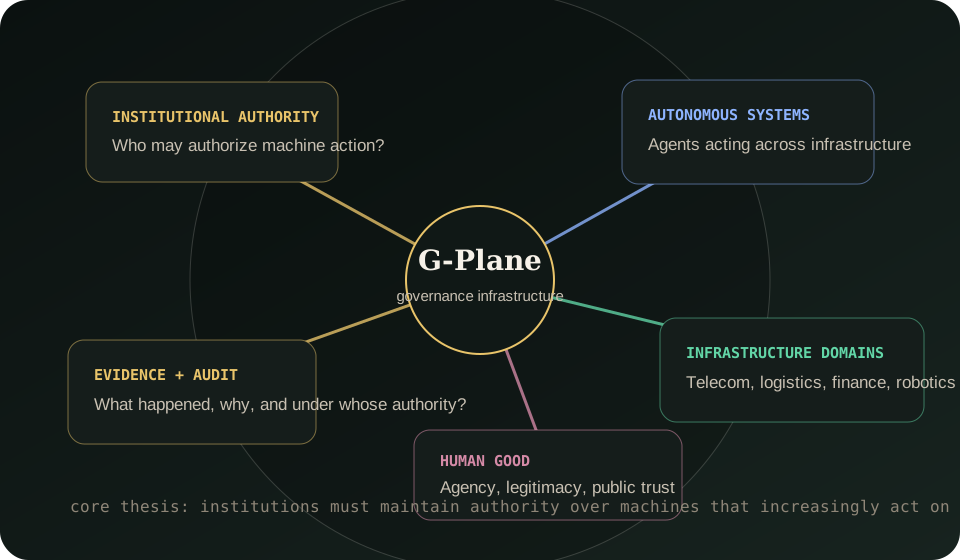
G-Plane architecture concept map
Book + technical paper + briefG-PlaneWards and warrants

The G-Plane Architecture: Governance Infrastructure for Autonomous Systems

Book manuscript, technical paper, and executive brief2026Revised constitutional runtime edition
AUTHORJ. D. "Pepper" Petersen
IMPRINTAristotle Agentic Press
YEAR2026

The book develops the wider architecture behind Aristotle Agentic: governance infrastructure for autonomous systems operating in telecommunications, logistics, financial systems, robotics, distributed computing, and other infrastructure environments.

The companion technical paper compresses that thesis into a publication-ready runtime architecture: Wards, Warrants, Commit Gates, Physical Invariant Gaters, and Governance Evidence Ledgers for consequential autonomous action. The executive brief gives funders, partners, and institutional sponsors the short strategic case.

Core contribution: governance is not a values wrapper. It is infrastructure that authorizes action before it becomes real.

Working papers.

These shorter papers extend the G-Plane thesis into deployment, risk, inter-domain authority, evidence, and runtime enforcement. They are public enough to read now and specific enough to guide the next build.

Working paper8 pagesRisk and adoption
INSURABLE AUTONOMY

Insurability and the Architecture of Autonomous Systems

Working paper2026Public draft

Autonomous systems become deployable when bounded authority, enforceable constraints, and reconstructable decision histories make risk inspectable enough for liability, compliance, and underwriting.

Open PDF
Working paper8 pagesProtocol design
AUTHORITY ROUTING

Authority Routing in Autonomous Systems

Working paper2026Public draft

A governance protocol for inter-domain autonomous action: systems advertise machine-readable authority envelopes and reconcile constraints before action crosses institutions.

Open PDF
Working paper7 pagesExecution layer
GOVERNANCE KERNEL

The Governance Kernel

Working paper2026Public draft

An operating-system architecture for deterministic governance of autonomous infrastructure, centered on a commit-point layer that decides whether an action is authorized before it becomes real.

Open PDF
Working paper7 pagesEvidence layer
EVIDENCE LEDGERS

Cryptographic Governance Evidence Ledgers

Working paper2026Public draft

A forensic record layer binding identity, authority, model lineage, policy state, and telemetry so institutions can reconstruct why a consequential action was allowed, refused, or escalated.

Open PDF

Civic AI.

The same authority problem appears in democratic language. AI can accelerate drafting, but the human institution must retain authorship, legal responsibility, and public legitimacy.

Civic AI authority and evidence map
Civic AI paper12 pagesDemocratic infrastructure

A New Precedent Born of AI

Civic AI paperJanuary 2026Public draft
AUTHORJ. D. "Pepper" Petersen
FIELDCivic language
YEAR2026

This paper documents AI-assisted civic drafting as a constrained institutional process, not machine authorship. It connects the G-Plane thesis to public language, legal process, transparency, and democratic responsibility.

Core contribution: civic AI is legitimate only when the human institution remains the author, authority, and accountable party.

Montana AI-X commentary.

These short pieces translate the institute's governance thesis into Montana language: energy, infrastructure, economic development, workforce readiness, and public trust.

Commentary2 pagesMontana AI-X
FROM COPPER TO CODE

Montana's AI Moment Has Arrived

Commentary2026Public draft

A place-based argument that Montana should treat AI as the next infrastructure question: not a coastal abstraction, but an adoption, energy, workforce, and public-trust challenge for the real economy.

Open PDF
Commentary2 pagesAI infrastructure
WRONG PART OF AI

Montana Is Arguing About the Wrong Part of AI

Commentary2026Public draft

A sharper AI-X position: data centers matter, but the deeper public question is how Montana governs adoption, workforce transition, institutional capacity, and trustworthy use.

Open PDF

Research stack.

The research program describes a coherent architecture, not isolated essays. Each track answers a different part of the same authority problem.

PUBLICATION STANDARD

The Research area publishes formal PDFs and institute-level summaries. Working drafts, confidential materials, filing records, and duplicative internal documents stay outside the public site unless they are deliberately prepared for release.

GOVERNANCE KERNEL

Commit-point authority enforcement

A minimal execution layer between autonomous decision systems and infrastructure. Its job is to ask whether an action is authorized at the moment it would become real.

Source: The Governance Kernel

AUTHORITY ROUTING

Inter-domain permission exchange

A governance protocol inspired by internet routing: autonomous systems advertise machine-readable authority envelopes and reconcile constraints before action crosses institutions.

Source: Authority Routing in Autonomous Systems

G-PLANE MESH

Distributed governance for agent networks

Offline-first governance embedded in each node, with Authority Envelopes, Execution Warrants, peer coordination, and tamper-evident evidence for disconnected environments.

Source: The G-Plane Mesh / GMesh briefing

EVIDENCE LEDGER

Non-repudiable execution records

A forensic layer binding identity, model lineage, delegated authority, and telemetry so institutions can reconstruct the governance state present at execution.

Source: Cryptographic Governance Evidence Ledgers

PHYSICAL INVARIANTS

Hardware-enforced last boundary

The Physical Invariant Gater separates policy validation from physical safety enforcement so autonomous commands cannot violate hardware or environmental limits.

Source: Deterministic Actuator Gating

INSURABLE AUTONOMY

Risk made legible enough to underwrite

Autonomous systems become deployable when bounded authority, enforceable constraints, and reconstructable decision histories make liability inspectable.

Source: Insurability and the Architecture of Autonomous Systems

RECURSIVE GOVERNANCE

Constitutional control over policy itself

Meta Authority Envelopes constrain downstream policy creation, blocking unilateral escalation and adversarial policy injection.

Source: Recursive Governance / Petersen Governance Architecture

AMENDMENT PROTOCOLS

How foundational constraints evolve

Multi-party constitutional amendment, quorum governance, semantic safety validation, and emergency override paths for the policy layer above policies.

Source: Multi-Party Constitutional Amendment Protocols

CIVIC LANGUAGE

AI as constrained drafting partner

A documentary account of AI-assisted civic drafting where the human institution retains authorship, legal authority, and responsibility for public language.

Source: A New Precedent Born of AI

Thesis graph.

Across the papers, the center of gravity is consistent: autonomous action needs a governed execution boundary, not just advisory ethics.

CONCEPT WEIGHT BY SOURCE
Authority chain
Commit boundary
Evidence / audit
Disconnection
Insurability
Civic legitimacy
ARCHITECTURE CLAIM
1. Institutions delegate authority to machines.
2. Machines act across networks, domains, and physical systems.
3. Connectivity and human attention are intermittent.
4. Governance must be local, deterministic, and inspectable.
5. Human authority remains the root of legitimate action.

Applied research lanes.

These tracks connect the technical thesis to the public-interest institute, the Training Hub, Montana AI-X, and AristotleOS.

AUTHORITYDelegated authority, warrants, Authority Envelopes, refusal-before-emission, and human approval as runtime objects.AristotleOS linked
DISCONNECTIONGovernance under network partition, edge operations, robotic swarms, field infrastructure, emergency response, and offline evidence.Technical thesis
EVIDENCECryptographic governance ledgers, replayable decision histories, audit records, model lineage, and institutional reconstruction after action.Accountability layer
INSURABILITYHow autonomous infrastructure becomes legible to risk, underwriting, liability, compliance, and regulated deployment.Market adoption
CIVIC AIPublic agencies, democratic accountability, public language, records, appeals, procurement, and civic drafting.Public-sector focus
WORKFORCEWhite collar, blue collar, apprenticeships, internships, fellowships, and AI-enabled work transition.Training Hub linked
MONTANA AI-XFrom Copper to Code, data-center debates, rural health, agriculture, energy, utilities, schools, broadband, and regulated sectors.Place-based track